AutoHome AI — Designing an Emotionally Intelligent Smart-Home Assistant
4 hours
AutoHome AI is a next-generation smart-home companion that blends intelligence, emotional awareness, and human-centered automation.
Overview
AutoHome AI helps individuals manage everyday household routines - from climate control to meal planning - through adaptive insights that learn from behavior, context, and mood.
Originally conceived as part of my Stanford UI/UX Design for AI Products capstone, AutoHome evolved into a high-fidelity prototype exploring trust-centered AI, explainability, and multi-device coherence across a modern smart-home ecosystem.
Problem
Smart assistants today often overwhelm users with control panels, fragmented apps, and non-transparent automation.
Interviews and surveys revealed three key frustrations:
Decision fatigue from managing repetitive household tasks.
Lack of contextual intelligence - systems don’t understand energy, emotion, or environment together.
Limited trust due to opaque automation and inconsistent feedback.
AutoHome AI set out to design an assistant that feels aware, calm, and collaborative - not controlling.
Research & Insights
conducted 3 interviews and 6 surveys with solo homeowners, neurodiverse users, and working parents.
Key insights shaped the design principles:
Cognitive load is invisible : users value emotional tone as much as efficiency.
Manual override builds trust : users want clear, reversible automation.
AI must show its reasoning : transparency creates emotional comfort.
These insights informed the interface philosophy: ambient clarity, empathy in microcopy, and progressive disclosure of system decisions.
Solution
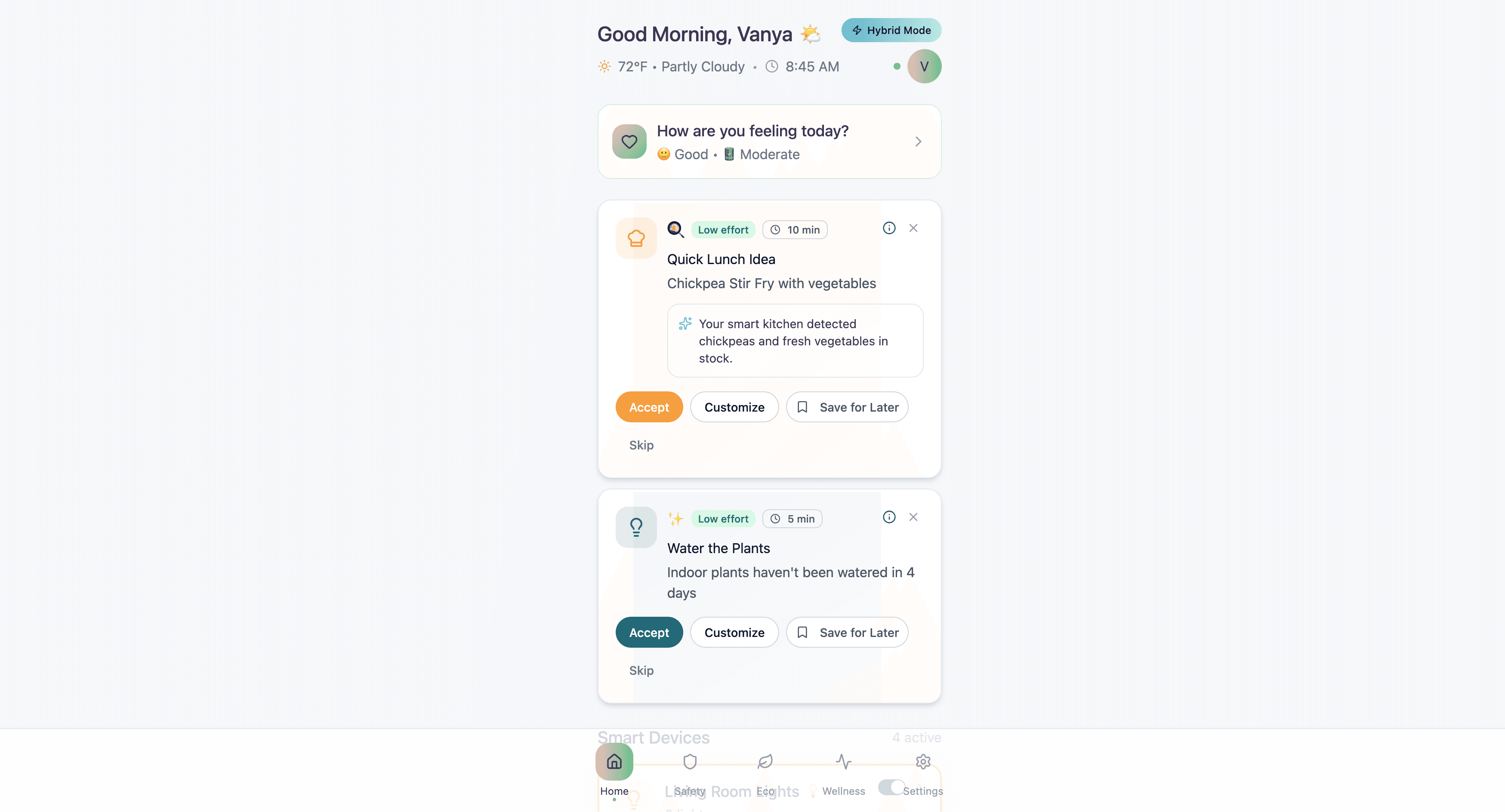
AutoHome AI organizes home management into one adaptive interface:
A dashboard that unifies all devices : Lights, Climate, Kitchen, Security, Music, EV, and Garden.
Routine Planner that syncs with mood and energy data to suggest or adjust schedules.
Sustainability Center to visualize energy and water usage with eco-suggestions.
Voice & Chat Mode that explains its reasoning and accepts feedback naturally.
Trust Dashboard allowing users to see and control what data powers automation.
Each feature aligns with Stanford’s Human-in-the-Loop AI framework - keeping the user central in decision-making.